Hindley Earnshaw's Death
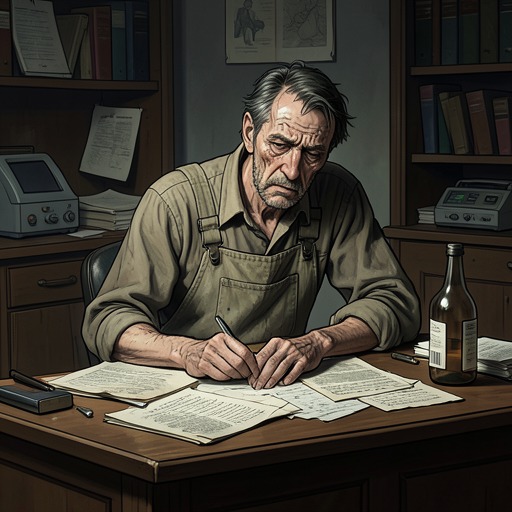
Wuthering HeightsHindley Earnshaw's Death is the grim culmination of a life consumed by dissipation, and the pivotal event that delivers Wuthering Heights into Heathcliff's hands. The death is reported by Mr. Kenneth, who tells Ellen Dean that Hindley died "true to his character: drunk as a lord." He was barely twenty-seven years old, the same age as Ellen herself, a fact that deepens the shock of the loss. Ellen confesses that this blow was greater to her than the death of Mrs. Linton, and she weeps for him "as for a blood relation," haunted by the persistent question of whether he "had fair play." The event is not merely a personal tragedy but a legal and economic turning point, as it exposes the full extent of Hindley's ruin and enables Heathcliff's formal takeover of the estate.
The Circumstances of the Death
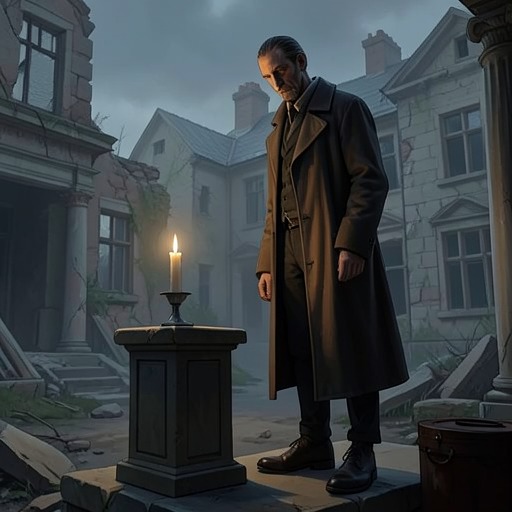
Heathcliff's own account of the death is delivered with characteristic coldness and contempt. He explains that he had left Hindley alone for ten minutes the previous afternoon, and in that interval Hindley fastened the two doors of the house against him and spent the night deliberately drinking himself to death. When they broke in the next morning, they found him "laid over the settle," already dead and cold, beyond the reach of any remedy. Heathcliff remarks that "flaying and scalping would not have wakened him," and he insists that the "fool's body should be buried at the cross-roads, without ceremony of any kind." Joseph, the old servant, mutters a telling dissent, wishing that Heathcliff himself had gone for the doctor, and insisting that Hindley was not dead when he left him. This detail casts a shadow over Heathcliff's version of events, suggesting negligence at the very least, and leaving the precise circumstances of Hindley's final hours ambiguous.
The Financial Ruin and the Seizure of the Estate
The deeper cause of Hindley's downfall is laid bare in the aftermath of his death. The lawyer informs Ellen that "his father died in debt; the whole property is mortgaged," and that the only chance for the natural heir, Hareton, is to "allow him an opportunity of creating some interest in the creditor's heart." That creditor is Heathcliff himself. Ellen learns that Hindley had mortgaged "every yard of land he owned for cash to supply his mania for gaming," and that Heathcliff had become the mortgagee. With Hindley dead, Heathcliff proves to the attorney, and the attorney in turn proves to Edgar Linton, that he now holds firm possession of Wuthering Heights. The guest has become the master. Hareton, who "should now be the first gentleman in the neighbourhood," is reduced to "a state of complete dependence on his father's inveterate enemy," living in his own house as a servant, deprived even of wages, and quite unable to right himself because of his friendlessness and his ignorance that he has been wronged.
The Aftermath and the Consolidation of Power
Hindley's death does not merely transfer property; it transforms the social order of the household. Heathcliff's position as master is cemented, and he immediately signals his intention to control the next generation. When Edgar Linton, prompted by Ellen, considers acting as guardian to his wife's nephew Hareton, Heathcliff issues a direct threat: he declares he has "a fancy to try my hand at rearing a young one," and warns that if Edgar attempts to remove Hareton, Heathcliff will "supply the place of this with my own." This hint is enough to bind Edgar's hands, and he speaks no more of interfering. The death thus becomes the foundation for Heathcliff's long-term scheme, which he later articulates openly: that the two cousins, Hareton and Catherine Linton, should fall in love and marry, so that he can consolidate his hold on both estates. The event also foreshadows the legal machinations that will follow, as Heathcliff's methods of acquiring and securing property through wills and mortgages become the central engine of the plot's later stages.
The Thematic Significance of the Death
Hindley's death is the logical endpoint of a character defined by excess and self-destruction. His "mania for gaming" and his dissipation are not merely personal failings but the instruments of his own dispossession, and Heathcliff's triumph is built directly on Hindley's ruin. The event also underscores the novel's preoccupation with property and inheritance as the true currency of power. Hindley's death is the moment when the Earnshaw line is formally broken, and the house passes to an outsider. The contrast between Heathcliff's cold, calculating account of the death and Joseph's muttered accusation highlights the moral ambiguity at the heart of the novel: Heathcliff may not have killed Hindley with his own hands, but he has certainly created the conditions for his destruction and profited from it. The death of Hindley, like the deaths that follow, is a transaction in Heathcliff's ledger of revenge, and it is the first clear demonstration of his willingness to use the law and economic power as weapons as deadly as any physical violence.